
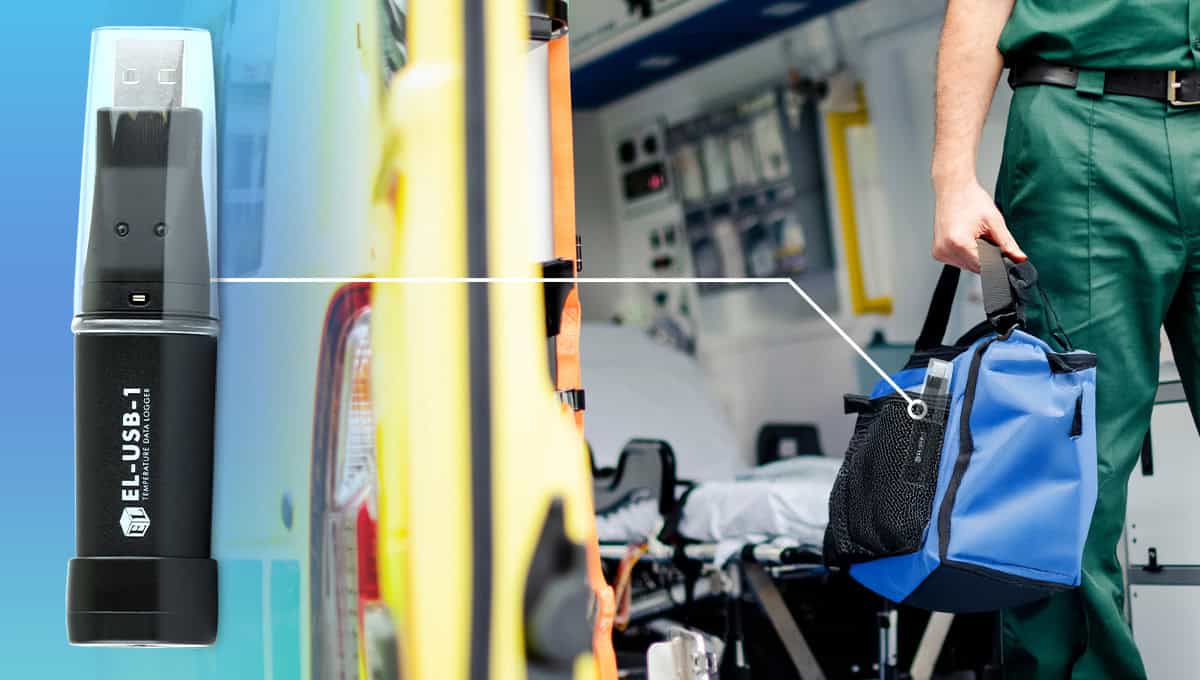
What Happens Between Locations Matters
Ambulance services and emergency response vehicles regularly transport temperature-sensitive medicines, vaccines and emergency medical supplies between hospitals, pharmacies and care settings.
While medicines are often stored within insulated medical bags, cool boxes or onboard refrigeration systems, maintaining visibility of transport conditions throughout the journey can present a significant operational challenge.
As temperatures rise during warmer months, ambulance services face increasing pressure to maintain confidence in medicine storage conditions whilst continuing to support rapid response operations.
Using supporting evidence from NHS Specialist Pharmacy Service, refrigerated medicines must remain within intended storage conditions throughout transport, with appropriate temperature monitoring and audit trails to support cold-chain compliance (2023).
The Visibility Gap in Ambulance Transport
Many medicines carried within ambulance vehicles, including vaccines, insulin and temperature-sensitive emergency medicines, must remain within strict temperature ranges to maintain their quality and effectiveness.
World Health Organization supports that maintaining this cold chain is critical, as preserving appropriate conditions ensures both the safety and efficacy of pharmaceutical products (2011).
This requirement extends across the entire journey, as mentioned by the UK Health Security Agency in the green book, as vaccines must be maintained within the recommended temperature range during storage and transport until the point of administration (Chapter 3, 2023).
Within ambulance environments, risks can increase during delays, extended transit times, multiple patient visits and periods where vehicles remain stationary in warm weather.
Whilst insulated medical bags help slow temperature change, they do not provide visibility of what happens during transport.
Without continuous monitoring, temperature excursions may go unnoticed.
Concerns surrounding the maintenance of temperature control in emergency response environments have also been highlighted in pre-hospital observational studies, including research conducted by Essex & Herts Air Ambulance (2022).
Why Temperature Monitoring Matters
A study by the NHS Specialist Pharmacy Service (2023) highlights the importance of continuous temperature monitoring during refrigerated medicine transport, including the use of calibrated data loggers to maintain accurate and traceable records.
Similarly, the Centers for Disease Control and Prevention (2023) notes that temperature monitoring devices provide documented evidence that medicines and vaccines remained within recommended storage conditions throughout transport, helping protect product integrity and patient safety.
This evidence is increasingly important for ambulance services and healthcare providers to demonstrate that medicines have remained within acceptable conditions.
Supporting:
- SOP compliance
- Audit readiness
- Quality assurance
- Medicines optimisation
- Operational confidence
Medicinal products should also be transported under conditions that maintain their quality and integrity throughout the supply chain, states Medicines and Healthcare products Regulatory Agency (2022).
Improving Visibility for Safe Medical Transport
As ambulance services continue to prioritise patient safety and compliance, improving visibility throughout transport is becoming increasingly important.
Temperature monitoring solutions can help teams:
- Identify temperature excursions
- Maintain audit records
- Improve transport traceability
- Support SOP and QA processes
Temperature monitoring solutions such as Lascar’s EL-WiFi and EL-USB data logger ranges can help ambulance services improve visibility and traceability during medicine transport.
As connected monitoring technologies continue to evolve, cellular-enabled monitoring may further improve visibility across mobile healthcare environments.
Because what happens between locations matters.
Sources
- Centers for Disease Control and Prevention (CDC) (2023) Vaccine Storage and Handling Toolkit.
- Essex & Herts Air Ambulance Trust (EHAAT) (2022) Temperature Monitoring in the Pre-Hospital Environment Observation Study.
- Medicines and Healthcare products Regulatory Agency (MHRA) (2022) Good Distribution Practice Guidelines.
- NHS Specialist Pharmacy Service (SPS) (2023) Temperature Control Whilst Transporting Medicines.
- UK Health Security Agency (UKHSA) (2023) Immunisation Against Infectious Disease: The Green Book.
- World Health Organization (WHO) (2011) Model Guidance for the Storage and Transport of Time- and Temperature-Sensitive Pharmaceutical Products.